
How to Improve On-Page SEO to Up Your Website’s Visibility
You’ll Need an On-Page SEO Audit for that

The above image shows when you need an SEO consultation, and very probably an on-page SEO optimization
Are you struggling to rank in a competitive niche or facing low search traffic?
Many businesses overlook the importance of on-page SEO.
They prioritize visuals and design over optimizing their website's content (blog) and structure.
Why should you do an on-page SEO audit then?
What can an on-page SEO audit reveal for a website?
poorly structured headings,
missing meta descriptions,
irrelevant keywords, that may be holding your website back.
As Search Engine Journal explains,
“On-page SEO lays the groundwork for maximizing search visibility. It helps search engines find and show your pages to users, boosts your brand’s trustworthiness, and enables you to create content that meets your audience’s needs”.
Acting on Your On-Page SEO Audit
Don’t panic if your website isn’t generating enough clicks or conversions!
It’s not too late to act.
Conducting an on-page SEO audit is the first step to regaining your calm.
The real progress begins when you implement changes based on the audit findings.
What are the actionable steps to improve on-page SEO to boost your website rankings?
Optimize for User Intent
Improve On-Page SEO by Focusing Keyword Optimization
Enhance Your H1 Heading for Better On-Page SEO
1. Optimize for User Intent
Search engines prioritize content that aligns with user intent.
This means creating content that directly answers users’ queries or solves their problems.
This is particularly true to get visibility in the age of AI: answering questions early on and providing solutions can be rewarding. It can result in your website being listed as the first source in AI Overviews, ChatGPT or similar LLMs.
According to HubSpot,
“On-page SEO is important, because it tells Google all about your website and how you provide value to visitors and customers”.
2. Improve On-Page SEO by Focusing on Keyword Optimization
Keywords remain a cornerstone of on-page SEO.
Where to place keywords for better visibility?
Place target keywords in:
headings,
meta descriptions,
your images’ alt texts,
in the anchor links,
and throughout your content.
Let’s summarise this with an image:
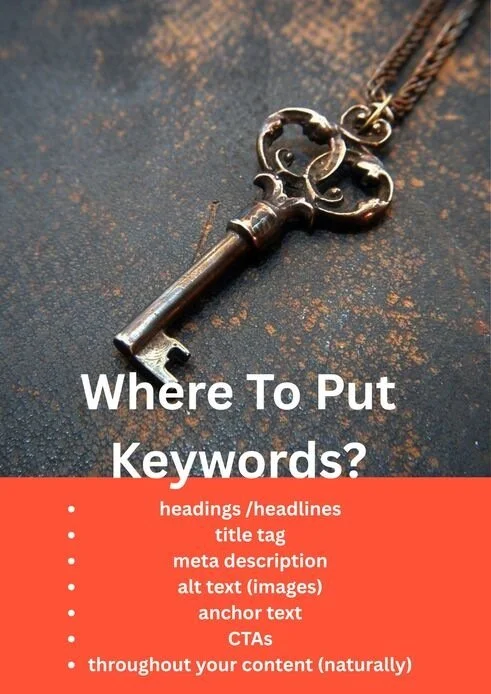
To improve on page SEO, monitor where you put your keywords.
Don’t do keyword stuffing!
Place them only there where they are expected, and that naturally.
3. Enhance Your H1 Heading For Better On-Page SEO
This is what I’m currently doing after I go through the statistics in Google Search Console (look below).
Monitor not only your keywords, but also GSC data!
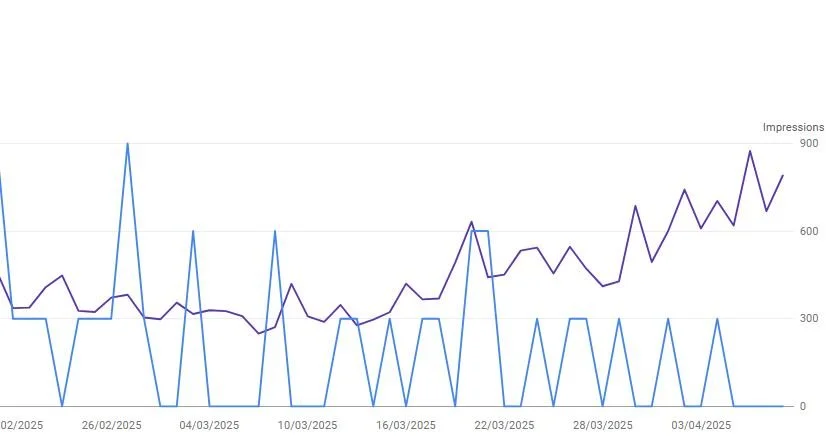
The blue lines are CLICKS, whereas the violet lines are for number of IMPRESSIONS.
GSC here shows an increase in impressions (from 300 to almost 900) with the number of clicks not increasing. Illogically, there are less clicks inspite of more impressions.
Above, you see that you need to make a few changes. You can start with the headings first.
You want to get more clicks to your website, right?
That’s not happening jugdiging by the above data, although Google keeps showing your website more often in the SERPS (search engine results pages).
I constantly upgrade my website, that is, I check whether i have built my webpages adequately, respecting the best SEO practices.
For that I use Seospace (a tool helping Squarespace websites optimize their content).
You’ll find a snippet from that tool below:
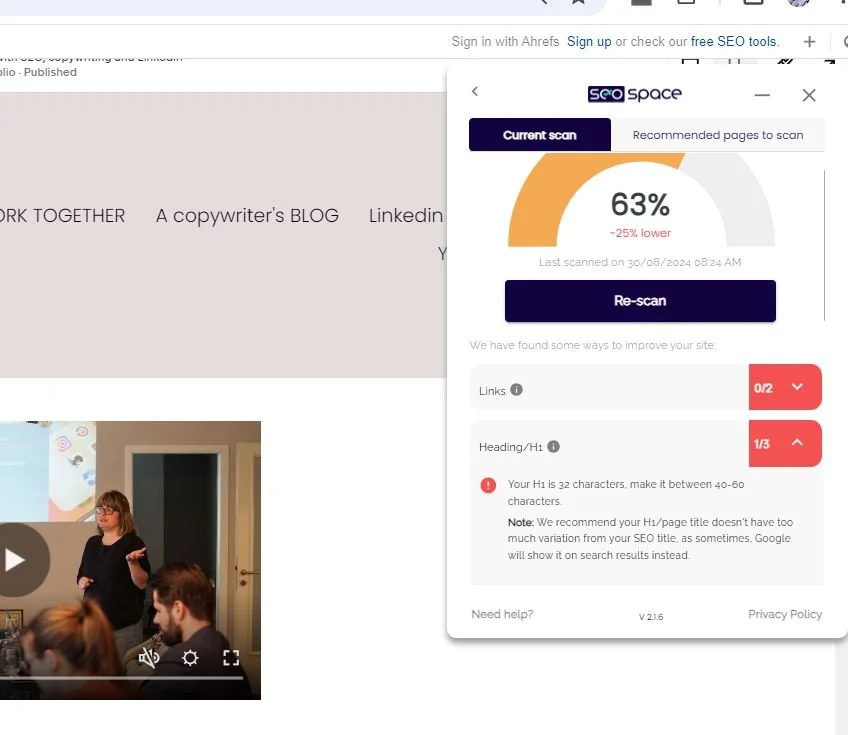
I’m using Seospace here to analyze how a particular web page is doing - it says that my H1 is too short: only 32 characters. H1’s should be at least 50-60 characters long.
Keeping track of our website’s progress with an on-page SEO tool
Your H1 heading plays a crucial role in signaling to Google what your page is about.
Many websites either lack an H1 or have multiple conflicting ones, which can confuse search engines.
Make sure your H1 includes a primary keyword like "improve on-page SEO" (if on-page SEO is your main traget word for that webpage) to help Google index your page effectively.
Tools and Data-Driven Insights to Improve On-Page SEO
Using tools like Hotjar can provide valuable insights into how users interact with your website. By analyzing heatmaps and click data, you can identify areas for improvement in layout and design.
For example, optimizing your homepage's hero section or tweaking call-to-action buttons based on user behavior can lead to better engagement metrics like reduced bounce rates and increased dwell time.
As AgencyAnalytics notes,
“On-page SEO shapes a client’s website experience by targeting elements like headlines, title tags, and user engagement metrics”.
These small but impactful changes can elevate your site’s performance in search results.
The Importance of Fresh Content for On-Page SEO
Creating fresh, high-quality content is another vital aspect of improving on-page SEO.
Regularly updating blog posts or adding new pages targeting relevant keywords signals to Google that your site remains active and valuable.
As Backlinko says,
“Google loves when sites consistently publish fresh content,” which can help you target more keywords and reach new clients”.
Final Thoughts: Why You Must Improve On-Page SEO
Improving on-page SEO is essential for increasing website visibility in search engine results pages (SERPs).
Without it, even the most visually appealing websites may struggle to attract traffic or convert visitors into customers.
Prioritize people-first content and optimize every element of your site for both users and search engines.
By conducting an audit, optimizing key elements like headings and keywords, and leveraging tools for data-driven insights, you can set your website up for long-term success in the competitive digital landscape.
In the end, watch this video as I explain how I helped a client get more clicks (boosted their website traffic) even with lower impression rates.
How I increased clicks on a website despite lower impressions: Working on on-page SEO optimization to achieve that.