How SEO Copywriting Helped an Accommodation Brand Rank on Page One
A Swiss Serviced Apartment Brand with a Strong Product but a Weak Homepage
This case study shows how a rewrite, and not a rebrand or paid ad is the fix.
It costs less, and you get to consult a competent copywriter. Not any big marketing agency that’ll just create a hype around it without analysing what lies beneath the ground.
So, in this case it was SEO copywriting that brought this accommodation brand back to front stage (and visibility).
Important to note here: The client came to me with the web page written in English based on the original German text!
I saw their problem right at the beginning of our collaboration.
More of them.
The brand had no organic visibility (pages were not indexed)!
There was no keyword alignment on their website before the copy rewrite.
No value proposition
No proper audience
Amanthos Living (amanthosliving.com), an accommodation brand, offers self-serviced apartments across three Swiss locations — Zurich Airport, Solothurn/Grenchen, and Nyon on Lake Geneva.
They approached me via LinkedIn after their marketing department booked a webinar on hero section copywriting.
The product is genuinely good: fully equipped apartments, digital check-in, professional cleaning, competitive pricing, and locations that matter to both business travellers and independent guests. But when the website launched, almost none of that came through in the copy.
First Problem - The Brand had no Organic Visibility
The brand was invisible online.
It wasn’t on Page 2 or 3. It simply didn’t rank at all for the English-language search phrases their target guests were actually typing!
And without organic visibility, every booking flowed through OTAs charging 15–25% commission.
The direct-booking website was, in commercial terms, decorative.
This case study shows you what I changed, why it worked, and what any accommodation brand—or any small business launching into a new market—can take from it.
Before the Copy Rewrite: Describing Instead of Convincing
The original homepage copy committed a mistake I see constantly in accommodation websites, especially those translated from another language into English: It described the product. It did not speak to the guest!
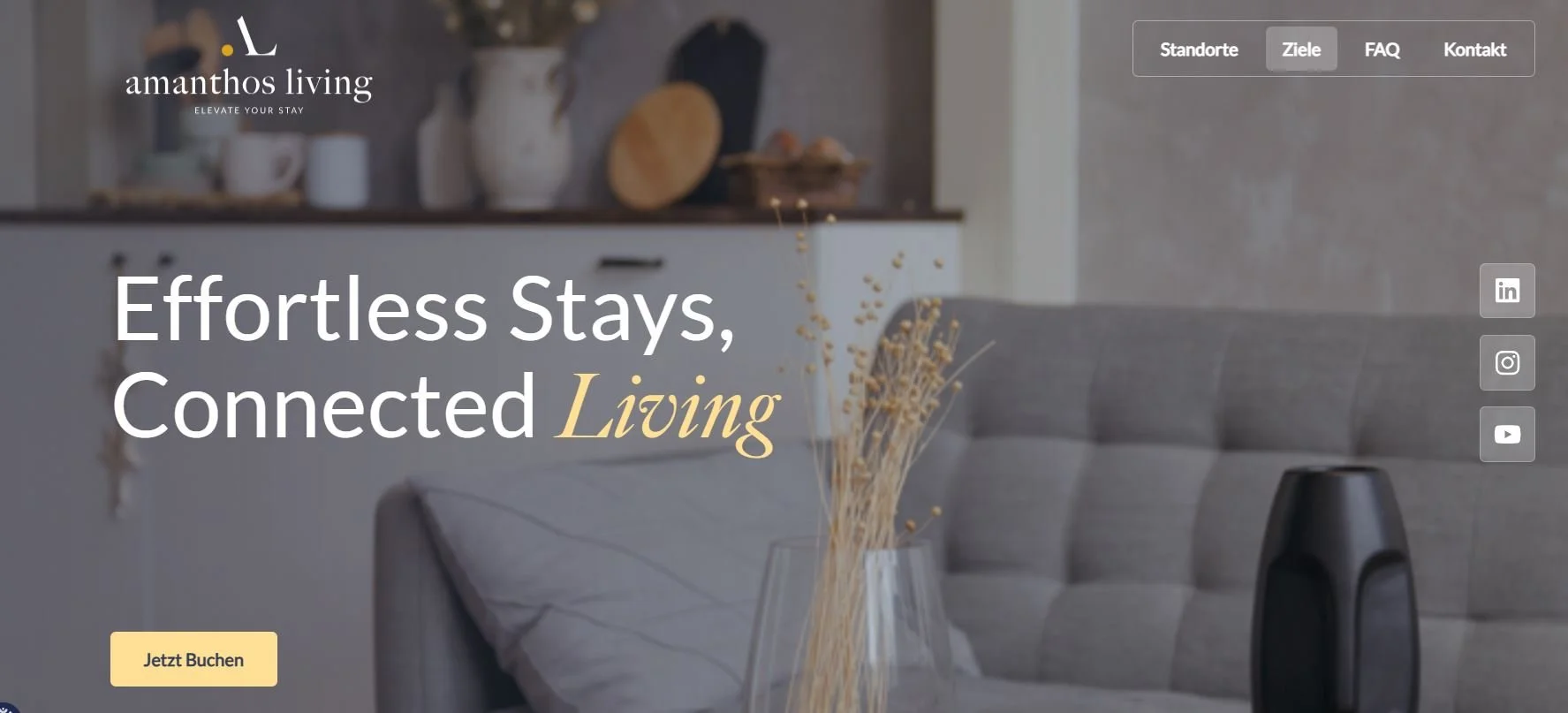
The headline announced what the company was (Effortless stays).
The subheading listed features (Connected living).
The copy was written in the first person plural — "We offer..." — a company-centric frame that research, testing, and practical experience all agree performs worse than guest-centric framing. The question "What's in it for me?" was never answered.
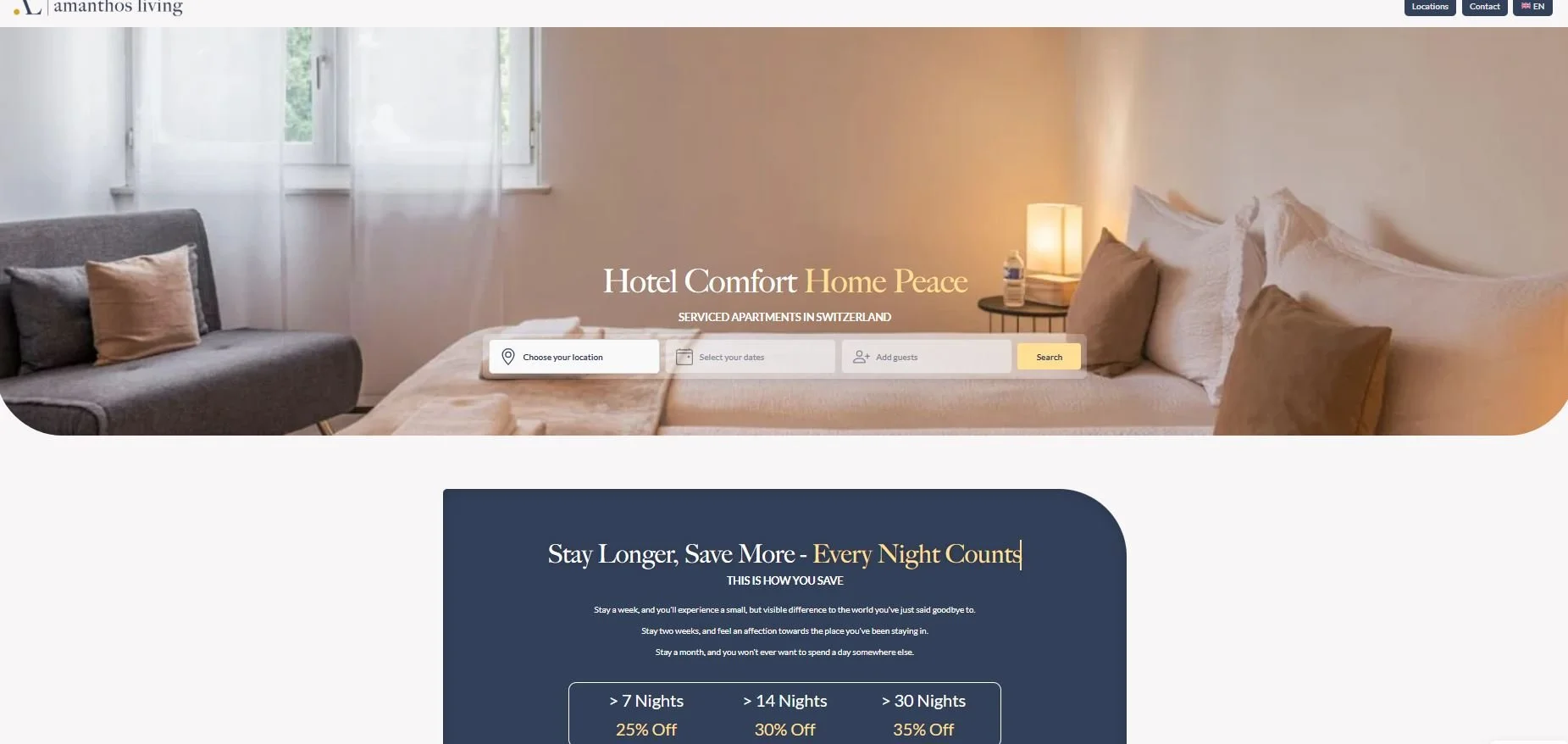
This above is the homepage, with parts of text written in German. Only the slogan was in English prior to my taking over the copywriting in English.
Three specific problems stood out immediately:
No keyword alignment. The phrase "self-serviced apartments Switzerland" — the most naturally searched term for Amanthos Living's exact product — did not appear anywhere on the homepage (see above).
Not in the headline, not in the opening paragraph, not in the meta title or meta description. For a new domain with no prior ranking history, this meant the page gave search engines no usable topical signal at all.
No value proposition. Amanthos Living's single strongest commercial argument — that a week in one of their apartments costs roughly a quarter of what an equivalent Zurich hotel would cost — was not mentioned.
The price advantage that could have converted a hesitant visitor into a booking was invisible.
No audience. The copy did not distinguish between the two very different people most likely to book : a business traveller arriving near Zurich Airport on a 3-week project, and a younger independent traveller looking for an affordable, self-catering alternative to Swiss hotel prices. Writing for both starts with understanding that they care about different things — and that a homepage can serve both without sacrificing clarity for either.
If you've ever wondered why well-written, carefully structured copy outperforms first-draft website text, the before state of amanthosliving.com is a textbook example.
You can see what good hospitality copywriting looks like versus what urgently needs improvement — the gap between the two is almost always the same: features versus benefits, company voice versus guest voice.