
Your Homepage Should Have a Proper SEO Website Audit!
Why having regular SEO audits of your homepage matters
An SEO website audit is a comprehensive analysis of your website’s performance. Such an audit checks the website’s performance in relation to the search engines.
It’s not only Google that counts!
Although most people use Google to get results for their searches, there are other search engines too.
Bing and DuckDuckGo, for instance.
And then there are those favoured in the Far East and by people who do not write in Latin script.
Beneath you’ll see a snippet where I rank very high on Google, and that for the keyword I wrote a post on for the hospitality sector.
I couldn’t have done this without regular audits and checks of Google Search Console in relation to the relevant keyword.
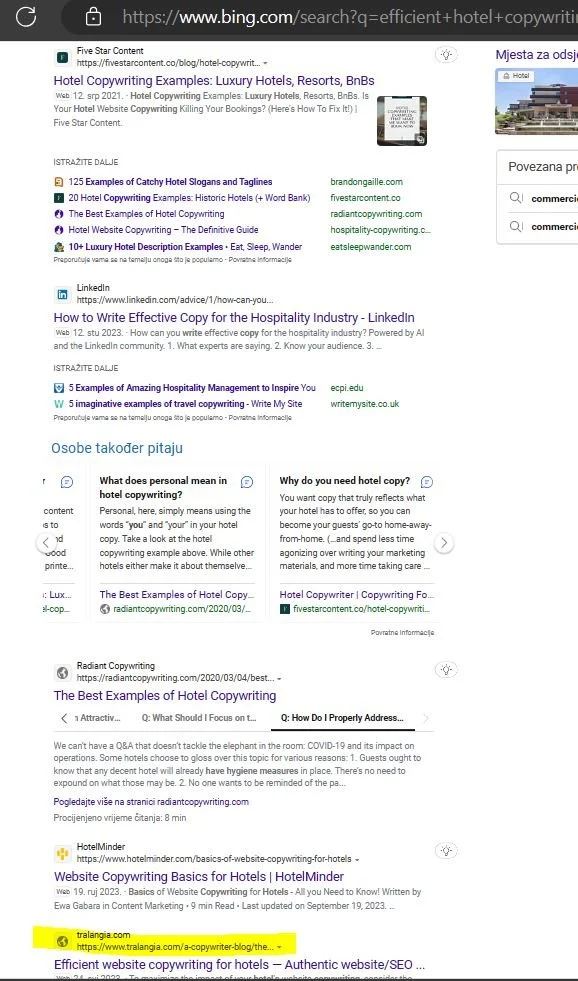
Bing search results for the keyword “effective hotel copywriting tips”
I rank as of 19th August on position 2 on Google. This is an earlier standing .
What’s the Goal of Regular SEO Audits?
These website audits are essential!
Just like publishing new content on your website.
I get that not many website owners want to invest in creating new content. Instead, they outsource that part of their website maintenance to freelancers who are copywriters or content creators.
But without creating new content, their website’s position on search engine ranking pages will stagnate, or worse, they will lose their position and give way to other websites competing with the same keyword they are using.
They will lose relevance; their content will gathers dust, while that of their competitors gets new life every time their team of writers gets together to produce new content.
Content that answers the queries of potential customers
That would be the answer to the question above.
Because in order to prepare their own responses and meet the needs of potential customers, website owners must also track what is currently typed into the search engines.
In short, it’s to prove how you as a brand and your website stand in terms of
VISIBILITY
USER EXPERIENCE
and
OVERALL EFFECTIVENESS.
How an SEO Website Audit Aids Website Visibility
Your website’s visible, if it succeeds in using the keywords many searchers (and potential customers) type into search engines in such a way that it offers them a solution.
By that I mean that the website has lot of content centered on one keyword often searched by many people.
It’s efficient in giving their searchers what they want—information, prices, testimonials, application data etc.—whatever they would like to know, and that presented in an easy way.
And then it manages to convince them to perform an action desired by the website- to buy, book, subscribe etc.
Work with Me on Seo Audits -Have Amazing Results in 1 Month!
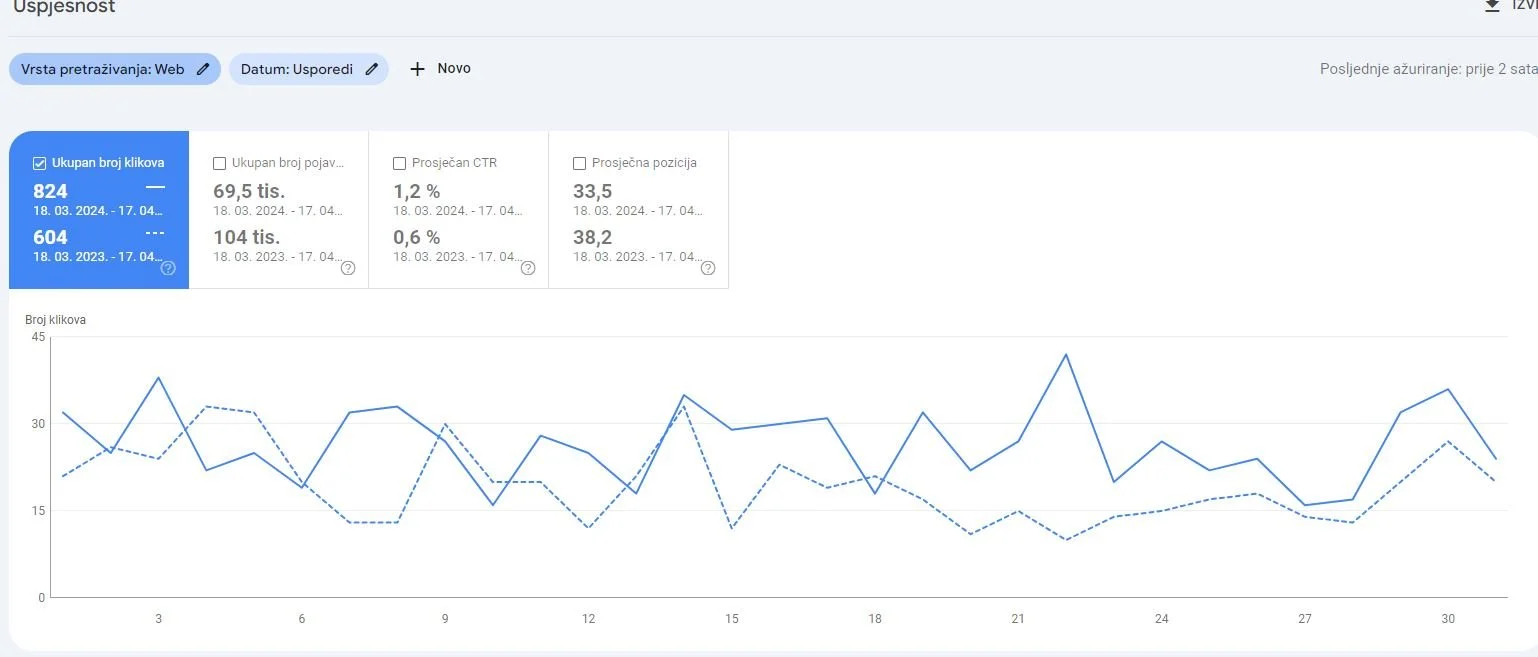
Here's a snippet from Google Search Console of a client of mine for whom I did homepage SEO optimisation. I did a comparison - I compared the number of clicks in 2023 and 2024 for the same period.
Although the number of appearances of the website decreased by some 30,000, I still managed to get 200 more clicks!
I increased the CTR rate (clickthrough rate)!
And the average position also increased! That only within a month of us working together!
The above snippet shows how visibility can increase.
So, why is an SEO website audit important?
An SEO website audit:
1. Improves Search Engine Rankings: An audit helps identify issues that may be preventing your site from ranking higher in search engine results pages (SERPs). By addressing these issues, you can improve your site’s visibility and attract more organic traffic.
2. Enhances User Experience: A well-optimized website provides a better user experience. An audit can uncover problems such as slow loading times, broken links, and poor mobile responsiveness, all of which can negatively impact user experience.
3. Identifies Technical Issues: Technical SEO issues, such as crawl errors, duplicate content, and improper use of tags, can hinder your site’s performance. An audit helps identify and fix these issues, ensuring that search engines can easily crawl and index your site.
4. Keeps Up with Algorithm Changes: Search engine algorithms are constantly evolving. Regular audits help ensure that your site stays up-to-date with the latest SEO best practices and algorithm changes.
5. Boosts Conversion Rates: By improving your site’s SEO, you can attract more targeted traffic, which can lead to higher conversion rates. An audit helps identify areas where you can optimize your site to better meet the needs of your audience.
No. 5, of course, is the main goal for many businesses. For that to happen, you must get all 4 right.
Now, let’s see which key areas you should look at in such a website audit from an SEO perspective.
Key Areas to Examine in an SEO Website Audit
On-Page SEO (I offer this service!):
Title Tags and Meta Descriptions: Ensure that each page has unique and descriptive title tags and meta descriptions that include relevant keywords.
Header Tags: Use header tags (H1, H2, H3) to structure your content and make it easier for search engines to understand.
Keyword Usage: Check that your target keywords are used naturally throughout your content, including in headings, body text, and image alt tags.
Content Quality:
Relevance and Value: Ensure that your content is relevant, valuable, and addresses the needs of your audience.
Originality: Avoid duplicate content, as it can negatively impact your SEO. Use tools to check for plagiarism and ensure your content is original.
Engagement: Analyze metrics such as bounce rate, time on page, and social shares to gauge how engaging your content is.
Technical SEO:
Site Speed: Use tools like Google PageSpeed Insights to check your site’s loading speed and identify areas for improvement.
Mobile-Friendliness: Ensure that your site is responsive and provides a good user experience on mobile devices.
Crawlability and Indexability: Use tools like Google Search Console to check for crawl errors and ensure that all important pages are being indexed by search engines.
Backlink Profile - Quality of Backlinks: Analyze the quality and relevance of the sites linking to you. High-quality backlinks from authoritative sites can boost your SEO.
Anchor Text: Ensure that the anchor text used in backlinks is relevant and includes your target keywords.
Disavow Toxic Links: Identify and disavow any toxic or spammy backlinks that could harm your site’s reputation.
User Experience (UX):
Navigation: Ensure that your site’s navigation is intuitive and user-friendly.
Design and Layout: Check that your site’s design is visually appealing and easy to navigate.
Accessibility: Make sure your site is accessible to all users, including those with disabilities.
Conclusion
Conducting an SEO website audit is essential for maintaining and improving your site’s performance.
By regularly auditing your homepage and addressing the above issues, you can enhance:
your site’s visibility,
user experience,
and overall effectiveness.
Focus on key areas such as on-page SEO, content quality, technical SEO, backlink profile, and user experience to ensure your site adheres to SEO best practices and stays competitive in search engine rankings.